“A set of tiles which is, not only the most accomplished by Domingos de Almeida, (…) but also one of the most extraordinary of all the rococo tiles. The dizzying fantasy and unbridled proliferation of decorative motifs, derived from ornamental engravings of Augsburg, the use of sparkling colours, such as the intense yellows of antimony, the multiplication of the heraldic elements and symbols of the bishopric and papal, are extraordinary in their delirious and intense fantasy”
(José Meco, Monuments, March 2006, nr. 24)
The headquarters of the bishopric of the Algarve transfer from Silves to Faro, in 1577, will be a turning point in the history of the city. The new status of this urban centre will materialize in a variety of ways, including interven- tions in space and city buildings – both in existing buildin- gs as in the construction of new buildings / equipment.
It is in this context that, during the bishopric of D. Afonso Castel-Branco (1581-1585), the Episcopal Palace was built.
After the earthquake of 1755, it was rebuilt and enlarged by D. Fr. Lourenço de Santa Maria (1752-1783), highlighting, on his drawing, the hipped roof and the portal. The interior is decorated with 18th century tiles, distributed by the atrium, the staircase and three rooms of apparatus.
The Episcopal Palace of Faro is one of the most representative buildings of the “Chã” Architecture in the Algarve.
PANELS OF VIRTUES
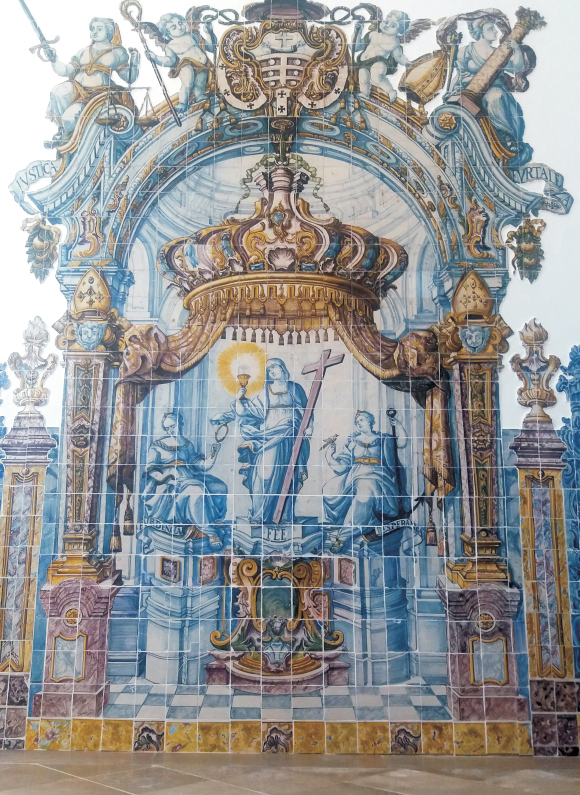 The Panel with an allegory of Charity, situated in the atrium, “surrounded by staircases and structures that look like a page of a treatise on architecture and set design”; the Panel of Virtues, located on the landing stage of the stairs, gives access to the noble floor of the late baroque, alluding to the Five Virtues of Prudence, Faith, Hope, Justice and Strength;the coat of arms of D. Fr. Lourenço de Santa Maria crowns the composition, flanked by two angels, enveloped by the pallium, topped by the hat of six tassels and the archiepiscopal cross. The composition is spectacular and absolutely appropriate. The Bishop’s house is the house of Faith. Whoever enters it must be accompanied of Hope, for it hopes to find there Prudence, Justice and Fortress (Pinheiro e Rosa).
ROOMS OF APPARATUS
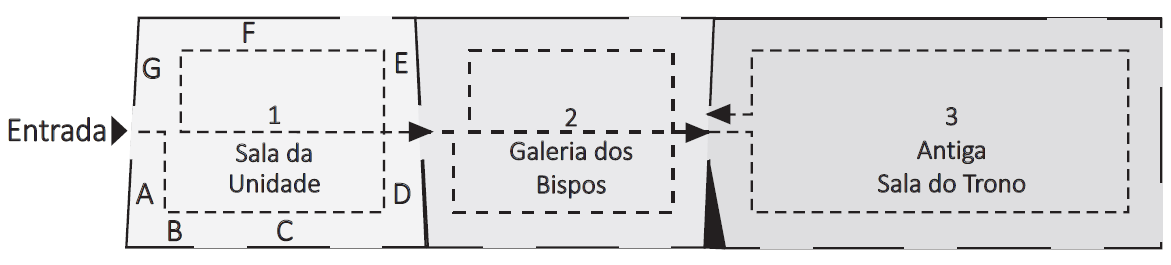
There are three: the antechamber room (waiting), the reception room and the throne room (solemn acts). In view of the present use, together with their original purpose, these rooms will be called the “Unit Room”, “Gallery of Bishops” and “Old Throne Room”.
UNIT ROOM
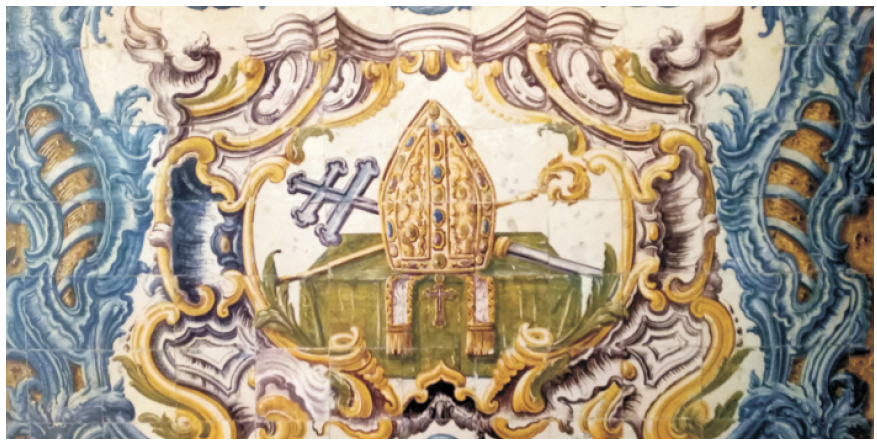
Unit and Communion Room, for it expresses, in a troub- led historical period for the Church (Pombalino: 1750-1777), the determination of Bishop Fr. Lourenço de Santa Maria in reaffirming the communion of the Diocese of the Algarve with the Pope, in opposition to the preten- sions of the political power of that time. This room expo- ses the richest tiles of the Palace. Each of the seven panels presents to the centre a shield with the keys of Peter, surmounted by the tiara (papal insignia) supported by two angels, having, on each side, a papal (triple) cross. At the extremes, the mitre is shown with the crosier, the torch lit, and a beam bound with a cingulate. The one indicated in the script proposed by the letter F is the greatest, most solemn, from and to which all the others converge, as an invitation to read them under an eccle- siological perspective, alluding to the Petrine / Papal ministries and Episcopal, the Eucharist (Paschal Lamb) being its source and summit, and unity and communion are its most expressive fruits.
Each panel has a central medallion with the presence of several references and symbology:
A. Medallion with boiler painted on a sage and, around it, several elements: cross, stole, towel, goblet cup, particle-
-filled pyramid cup, chalkboard book and gum bottom.
B. It presents a medallion with the table of the loaves of bread and the candelabra of seven lights.
C. The medallion represents the serpent, the apple, the Tablets of the Law, cobs, bunches of grapes and a small book, all on top of a sage.
D. Representation of a sage emerging from a veil, having painted in the background a chalice with a superimposed host and a serpent on the side. Around it, a wreath, a cross, two candles, a towel, a pyx, an open-edged book and a candlestick.
E. Decorative elements equal to those of the previous one, presenting in the central medallion a cloth with a dove, canes, stoles, the book of chant, a candlestick and a cross with a crucifix.
F. This panel extends to all available space: the central medallion (heart of this panel) presents a lamb lying on a sealed book with seven seals, to indicate the glorification of Christ, the “Lamb”, “He who is worthy to receive the book and to break the seals “(Rev. 5: 9); the triangle (BS) with the Hebrew tetragram inside (YHWH = JAVÉ) reveals the Lamb’s divine identity; the presence of the cross shows us that he is Christ “our Easter, immolated”, the bread of life (chalice and pyxis with hosts), the Eucharis- tic foundation of unity and communion in the Church, the priesthood and the episcopal and papal ministry: the arms of D. Fr. Lourenço de Santa Maria, situated on an inferior plan to the keys of Peter and the papal tiara, as a sign of obedience and ecclesial communion; elements suggestive of the liturgical and prayerful environment in which this reality is celebrated and updated; the sticks to indicate the stance of the steadfast and faithful shepherd, who does not yield to the hostile environment that surrounds him.
G. Oval medallion, with ribbon and border of foliage,
representing the sun and an elephant. Around it there are canes, a corporal vestment, a book, a sage, candles, a torch, shoots and bunches of grapes.
GALLERY OF BISHOPS
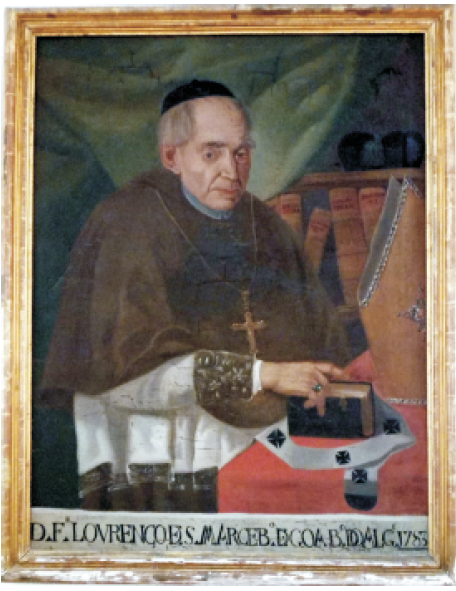
In this room, there is an ashlar of polychrome tiles, without cutouts, in white, blue, yellow, green and blood colour. It displays Baroque ornaments, among which are the acanthus leaves and windings. The motifs are repeated around the room, adapting the composition to the size of the wall. The paintings present, in chronological order, some of the bishops whose action was most signi- ficant, since the transfer of the bishopric’s headquarters to Faro. It is emphasized here D. Fr. Lourenço de Santa Maria (in the photo).
OLD THRONE ROOM
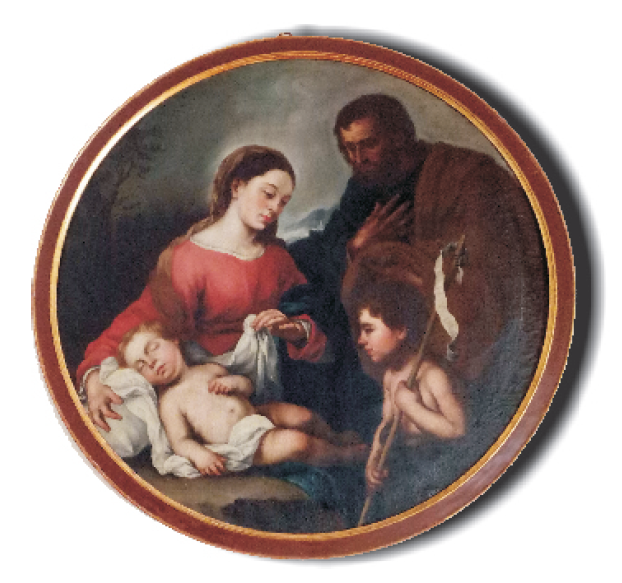
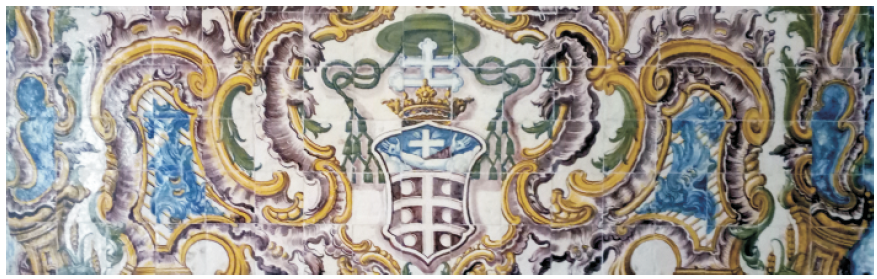
It presents wainscoting of tiles from the Rococo period, with a chromatic palette similar to the previous room, representing (the center) the coat of arms of Bishop D. Fr. Lourenço de Santa Maria. Also, in this room, the motif repeats itself, adjusting the composition to the area of the walls. There are also paintings from the collection of sacred art from the Episcopal Palace and some images of small dimensions, an expression of the personal devotion of some Bishops of the Algarve.
OPENING HOURS
Monday to Saturday
10h00 _ 13h00
14h00 _ 18h00
PREÇO DOS BILHETES
Individual Ticket – 5,00€
Group Ticket (≥ 15 pax) – 2,50€ /pax
Children up to 14 years olds – free
Students up to 25 years old – 2,50€
From the age of 65s – 2,50€

FARO’S EPISCOPAL PALACE
Largo da Sé, n.º 15
8000-138 Faro
Tel. (+351) 289894040
Email: casaepiscopal@diocese-algarve.pt – servicosdepastoral@diocese-algarve.pt
www.diocese-algarve.pt